
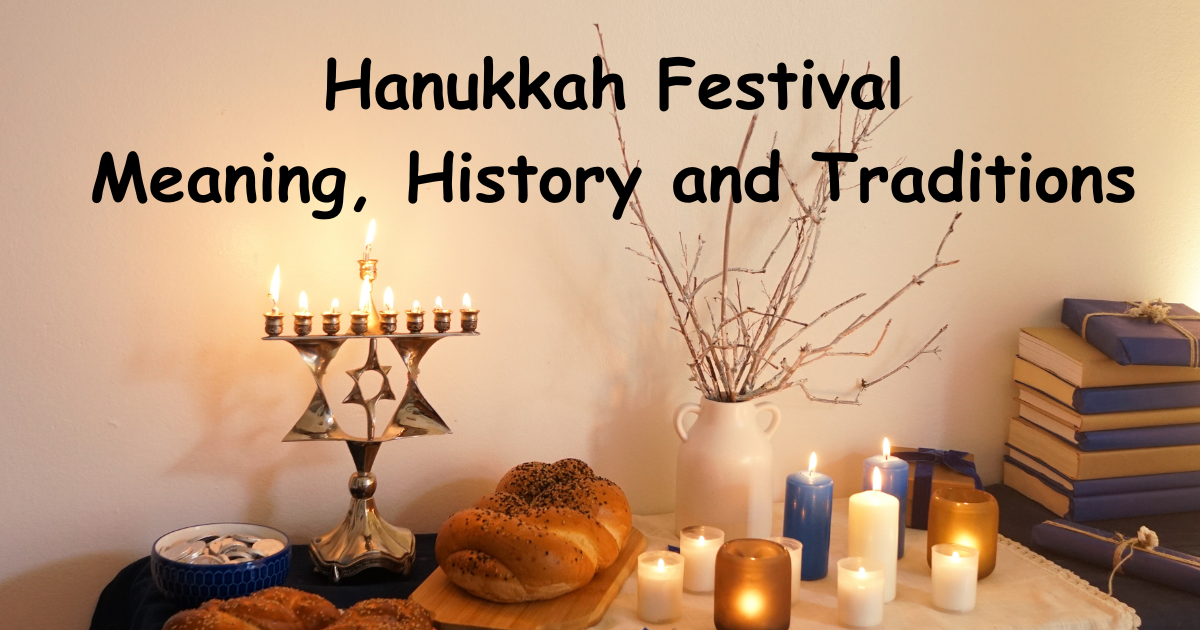
Hanukkah, also known as the Festival of Lights, is one of the most beloved and visually stunning festivals in the Jewish calendar. Observed for eight nights and days, it usually falls in late November or December. While it is often compared to Christmas due to its proximity in the winter season, Hanukkah has a distinct historical and religious identity. It is a celebration of a military miracle, a spiritual triumph of light over darkness, and the enduring resilience of the Jewish people.
In this exhaustive guide, we explore the revolutionary history of the Maccabees, the miracle of the oil, the symbolic meaning of the Menorah, and how Hanukkah is celebrated in modern homes around the world.
1. The Etymology and Meaning of Hanukkah
The word “Hanukkah” (or Chanukah) is derived from the Hebrew verb meaning “to dedicate.” ### The Rededication of the Temple
The name refers to the historical rededication of the Second Temple in Jerusalem during the second century BCE. After the Temple had been profaned by foreign occupiers, the Jewish people reclaimed it and consecrated it once again for holy service.
The Spiritual Significance
Beyond the literal dedication of a building, Hanukkah symbolizes the “dedication” of the soul. It represents the idea that even a small amount of light (truth and faith) can dispel a vast amount of darkness (oppression and ignorance).
2. The History: The Revolt of the Maccabees
To understand Hanukkah, one must look back to the year 168 BCE, when the land of Israel was under the rule of the Seleucid Empire (Syrian-Greeks).
The Tyranny of Antiochus IV
The Seleucid King, Antiochus IV Epiphanes, sought to force the Jewish people to abandon their customs and adopt Greek culture (Hellenization). He outlawed the study of the Torah, prohibited the observation of the Sabbath, and went as far as erecting an altar to Zeus inside the Holy Temple in Jerusalem, even sacrificing pigs upon it.
The Rise of the Maccabees
In the village of Modi’in, a Jewish priest named Mattathias and his five sons refused to bow to the Greek gods. They fled to the mountains and began a guerrilla war against the massive Syrian-Greek army. After Mattathias passed away, his son Judah, known as Ha-Makabi (The Hammer), took command.
Against all odds, the small, poorly armed band of Jewish fighters—the Maccabees—defeated one of the most powerful armies in the world and liberated Jerusalem in 164 BCE.
3. The Miracle of the Oil
When the Maccabees entered the Holy Temple, they found it in ruins and filled with idols. They immediately began to cleanse and restore it.
The Menorah
A central part of the Temple service was the lighting of the golden Menorah (candelabra), which was supposed to burn continuously. However, the Greeks had defiled almost all the jars of sacred olive oil. The Jews found only one small jar that still had the seal of the High Priest intact.
Eight Days of Light
This jar contained only enough oil to last for one day. It would take eight days to press and consecrate new oil. They lit the Menorah anyway, and according to tradition, a miracle occurred: the tiny flame continued to burn for eight full days, until the new supply of oil was ready. This is why Hanukkah is celebrated for eight nights.
4. The Symbols and Traditions of Hanukkah
Hanukkah is rich with unique customs that engage all the senses—from the glow of the candles to the smell of fried foods.
Shutterstock
The Chanukiah (The Menorah)
The most important tradition is the lighting of the Chanukiah, a nine-branched candelabra.
- The Shamash: The ninth candle, usually set higher or lower than the others, is called the “helper” or Shamash. It is used to light the other eight candles.
- The Lighting Order: On the first night, one candle is lit. On the second night, two are lit, and so on, until all eight are burning on the final night. Candles are placed from right to left (like Hebrew text) but lit from left to right (the newest candle first).
Playing with the Dreidel
The Dreidel is a four-sided spinning top with a Hebrew letter on each side: Nun, Gimmel, Hei, Shin.
- These letters stand for the phrase: “Nes Gadol Hayah Sham” (A Great Miracle Happened There).
- The Origin: Legend says that when the Greeks forbade Torah study, Jewish students would study in secret. If Greek soldiers approached, they would hide their scrolls and pretend to be playing with tops.
Hanukkah Gelt
Traditionally, children are given “Gelt” (Yiddish for money) during Hanukkah. In modern times, this is often substituted with chocolate coins wrapped in gold or silver foil. It is meant to reward children for their Torah studies and to teach them about charity (Tzedakah).
5. The Culinary Traditions: The Importance of Oil
Because Hanukkah celebrates the miracle of the oil, it is traditional to eat foods fried in oil.
- Latkes: These are potato pancakes, typically served with applesauce or sour cream. In Eastern Europe, potatoes were a winter staple, and frying them in oil connected the meal to the holiday.
- Sufganiyot: These are deep-fried, jelly-filled donuts topped with powdered sugar, extremely popular in Israel.
- Sfinge: In North African Jewish traditions (Morocco, Algeria), these are airy, honey-dipped fritters.
6. Hanukkah vs. Christmas: Clearing the Confusion
Because they occur around the same time, Hanukkah is often misunderstood as “the Jewish Christmas.” However, they are fundamentally different:
- Theology: Christmas celebrates the birth of a central religious figure; Hanukkah celebrates a national liberation and a miracle of light.
- Status: In the Jewish religion, Hanukkah is a “minor” festival (unlike Rosh Hashanah or Yom Kippur), but its visibility has grown in Western culture due to its timing.
- Gift Giving: While gift-giving is common today, traditionally Hanukkah was focused on small coins (Gelt) and family time.
7. Global Celebrations: Hanukkah Around the World
Hanukkah is celebrated by millions of Jews globally, with fascinating local variations.
Israel: Public Display
In Israel, the holiday is highly nationalistic. Giant Chanukiahs are placed on top of public buildings, including the Knesset (Parliament). Children have school holidays, and “Sufganiyot” bakeries see massive lines.
The United States: The National Menorah
Since 1979, the President of the United States has participated in the lighting of the National Menorah on the White House grounds. Hanukkah in the US is often a time for large communal gatherings and “Hanukkah Parties.”
India: The Jewish Community of Mumbai
The Bene Israel community in India has celebrated Hanukkah for centuries. They often use coconut oil for their lamps, reflecting the local resources, and prepare “Burfi” or “Chikvi” as festive sweets.
Ethiopia: Sigd and Hanukkah
The Beta Israel community (Ethiopian Jews) has unique customs, though many have adopted the standard Hanukkah traditions since immigrating to Israel.
9. Frequently Asked Questions (FAQs)
Why is Hanukkah eight days long?
It commemorates the miracle in the Temple where a one-day supply of sacred oil lasted for eight days until new oil could be prepared.
Can I light the Menorah with oil instead of candles?
Yes! In fact, many people prefer using olive oil lamps because they more accurately represent the original miracle in the Temple.
What is the ninth candle on the Menorah for?
It is called the Shamash. Since the Hanukkah lights are considered holy and cannot be used for any practical purpose (like reading or lighting other things), the Shamash is used as the “work” candle to light the others.
Is Hanukkah mentioned in the Bible?
Hanukkah is not mentioned in the Hebrew Bible (Tanakh) because the events took place after the Bible was canonized. However, it is recorded in the Books of the Maccabees (Apocrypha).
10. Conclusion: Finding Light in Modern Times
The story of Hanukkah is as relevant today as it was 2,000 years ago. It is a story about the fight for religious freedom, the courage of the few against the many, and the belief that hope—like a small jar of oil—can exceed all expectations.
As families gather to light the candles, sing traditional songs like Ma’oz Tzur, and enjoy fried delicacies, they are not just reenacting an old story. They are reaffirming their commitment to bring light into a world that often feels dark. For the readers of wishz.live, Hanukkah serves as a powerful reminder that “dedication” to one’s values is the ultimate source of strength.
Stay tuned to wishz.live for more deep-dives into global festivals, cultural history, and lifestyle tips. Don’t forget to share this article with your friends and family during the holiday season!